4399.com can be an interesting place to explore. It is a Chinese games site that allows users to play online browser games as well as flash games and also has a large collection of android games and apps. It even has side projects including 4399dmw.com/donghua which is an anime encyclopedia similar in some ways to myanimelist.net. China is well known for being the origin of many bootlegs and unlicensed content. This is the case for 世纪末的魔术师, also known as The Last Wizard of the Century.
This game is a flash-based visual novel in Chinese using the entirety of the movie and soundtrack for content. While the game does feature still frames taken from the movie as backgrounds, other parts of the game use whole sections of animation taken from the movie. This game is certainly unlicensed, and is a very interesting example of what someone can create.
Continuing the series of unusual ways to watch Anime on the GBA is this look at the Japan exclusive GBA accessories, the PLAY-YAN and PLAY-YAN micro. The PLAY-YAN was also released in Europe under the name 'Nintendo MP3 Player', and 'MP4 Player for GBA' in China by the company iQue, which is well known for distributing Chinese Versions of Nintendo products [3].
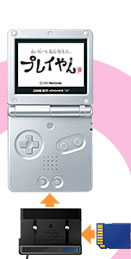
The PLAY-YAN was a portable audio and video player developed and released by Nintendo for the Gameboy Advance SP that was capable of playing .ASF format movies and .mp3 format audio from standard SD cards of up to 2 GB in size [1] [2]. The adaptor was also compatible with the Gameboy Micro and the Nintendo DS [1]. The device was similar in concept to AM3's Smart Media Player in that it could play media files off of a media card, except for the fact that the PLAY-YAN used SD cards, could be used to play audio files in addition to videos and that the PLAY-YAN allows users to add their own files and play them. The PLAY-YAN retailed in Japan at a price of 5, 000 yen.
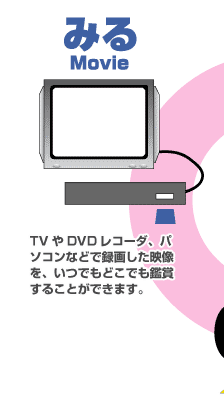
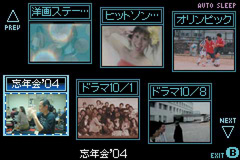
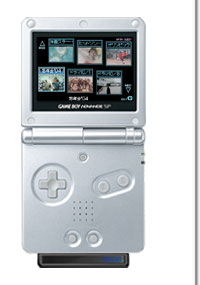
The PLAY-YAN could play .asf files recorded from TVS, PCs, and DVD recorders. The movie list is displayed with thumbnails to make it easier to find a particular video [1].
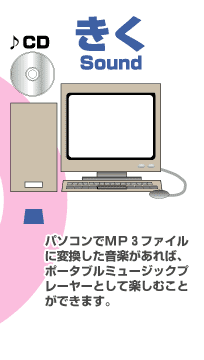
The .mp3 format audio files on the PLAY-YAN can be played with shuffle and song repeat. The file browser supports ID3 tags, as well as allows files to be nested within folders. You can also adjust the surround effect level and set the bass effect [1]. Pressing the 'A' button while listening to music can activate a secret minigame. More details can be found here.
The official Nintendo page for the PLAY-YAN also has a 'garage' section which offers 12 downloadable minigames, as well as a 13th hidden game at the bottom of the page which can be found here. As of September 11 2005, the PLAY-YAN was discontinued in favour of the PLAY-YAN micro.
Alongside the release of the Gameboy Micro in Japan, an updated version of the device known as the PLAY-YAN micro was released also for 5,000 yen. The PLAY-YAN micro, in addition to the .asf playback of the original now also supports .mp4 formatted videos as well as had improved audio quality through the inbuilt headphone jack. The PLAY-YAN micro removed support for the minigames. The PLAY-YAN micro was only available through Nintendo of Japan's online store, and could come with a computer program on a CD called 'MediaStage Ver. 4.4 for Nintendo', which allowed users to manage video and music files on a computer. This program would cost an additional 1,000 yen [3].
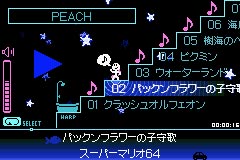
The sick-figure that appears in the music menu on the Japanese version of the hardware is also a character from the Japanese exclusive GBA game Rhythm Tengoku as well as the arcade game Night Walk ans was later used as a visualisation on the 3DS for its sound feature [3].
Information sourced from Wikipedia: [x]
In Japan in 2003, the AM3 Smart Media Player was released which allowed users to watch anime from special Smart Media Cards. This would never become popular internationally due to the release of Gameboy Advance Video.
A YouTube Video About GBA Video
GBA Video consisted of a series of standard sized GBA carts each with a compressed video on them. The cartridges were developed by 4Kids Technology [1]. The cartridges had a uniquely coloured light-grey/white shell in contrast to the dark grey shell of regular GBA carts. Videos on the carts were in 240x160 resolution, the regular resolution of GBA games, except for the Shrek and Shark Tales pack which was at 112p [2].
GBA Video was released in North America in May 2004 [x]. In November 2005, Majesco started to sell full-length animated films [x]. Due to license agreements with the owners of the television series, GBA Video Paks will not work on the GameCube Gameboy Player, using a the same logo authentication check used by games that support controller rumble, and will instead freeze on a screen "Not compatible with Game Boy Player" [x].
"Brobot"
"The Big Pinch"
"Granny Baby"
"Time is Money"
All Grown Up! vol. 1
"Susie Sings the Blues"
"Coup de Ville"
Cartoon Network Collection vol. 1
Ed, Edd 'n Eddy: "Stop, Look and Ed"
Courage the Cowardly Dog: "Magic Tree of Nowhere"
Johnny Bravo: "The Perfect Gift"
The Grim Adventures of Billy & Mandy: "Crawling Niceness"
Cartoon Network Collection vol. 2
Codename: Kids Next Door: "Operation T.U.R.N.I.P."
Courage the Cowardly Dog: "Courage the Fly"
Johnny Bravo: "Balloon Platoon"
The Grim Adventures of Billy & Mandy: "Mandy the Merciless"
Cartoon Network Collection Limited Edition
Ed, Edd 'n Eddy: "Key to My Ed"
Courage the Cowardly Dog: "The Queen of the Black Puddle"
Codename: Kids Next Door: "Operation M.I.N.I.G.O.L.F."
Dexter's Laboratory: "Big Sister"
Cartoon Network Collection Platinum Edition
Codename: Kids Next Door: "Operation T.O.M.M.Y."
The Grim Adventures of Billy & Mandy: "A Grim Surprise"
Courage the Cowardly Dog: "Cowboy Courage"
Ed, Edd 'n Eddy: "The Luck of the Ed"
Cartoon Network Collection Premium Edition
Dexter's Laboratory: "Double Trouble"
Courage the Cowardly Dog: "The Shadow of Courage"
Johnny Bravo: "Cookie Crisis"
Ed, Edd 'n Eddy: "A Glass of Warm Ed"
Cartoon Network Collection Special Edition
Ed, Edd 'n Eddy: "Oath to an Ed"
Johnny Bravo: "Beach Blanket Bravo"
The Grim Adventures of Billy & Mandy: "Billy and the Bully"
Dexter's Laboratory: "Dexter's Rival"
Video game consoles have had a lot of accessories throughout the years, all the way from retro consoles like the Atari VCS with its Starpath/Arcadia Supercharger of Coleco Kid Vid Voice Module accessories, to modern consoles such as the Xbox and PlayStation consoles, and this was no different for handheld consoles such as the GBA. Now, users have to anime, TV shows and movies on their consoles, phones and computers, but it was always like this.
Looking at the title, you may be wondering why anyone would want to watch video on the Gameboy Advance, but this is actually a unique way to watch anime on a video game console, when streaming anime online was not as accessible as it is now, and when handheld systems did not have the ability to access the internet. Apparently this topic is so unique, that even Wikipedia does not have an article on this topic. Also coming back and editing this article with further details, the version that was released that was designed to just play the anime cards is officially called 'Advance Video' [7].
In the United States and internationally, Game Boy Advance Video cartridges were made available which on standard Gameboy Advance cartridges contained a heavily compressed copy of one of many series or movies. A large list of animated television episodes and movies were released. In Japan however, AM3's own system existed which allowed users to view videos on their Gameboy Advance systems from smart media cards.
Gameboy Advance Video Advertisement (source: YouTube)
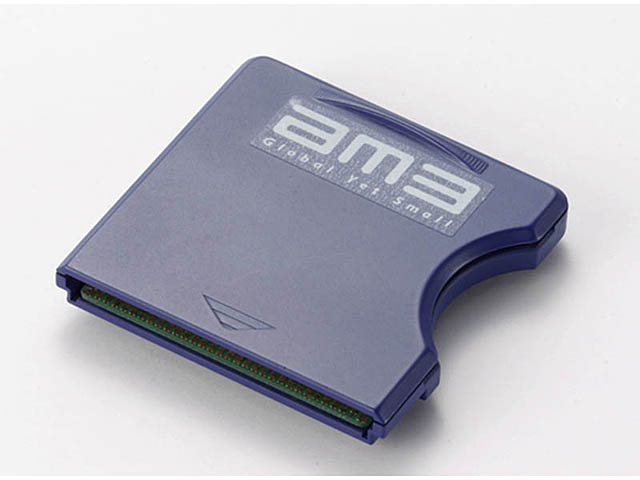
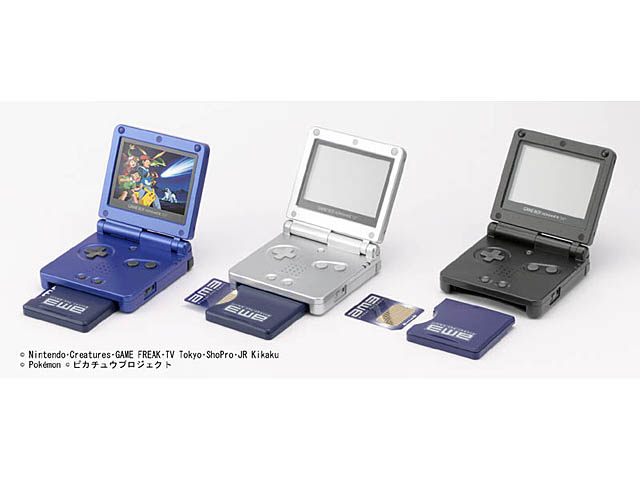
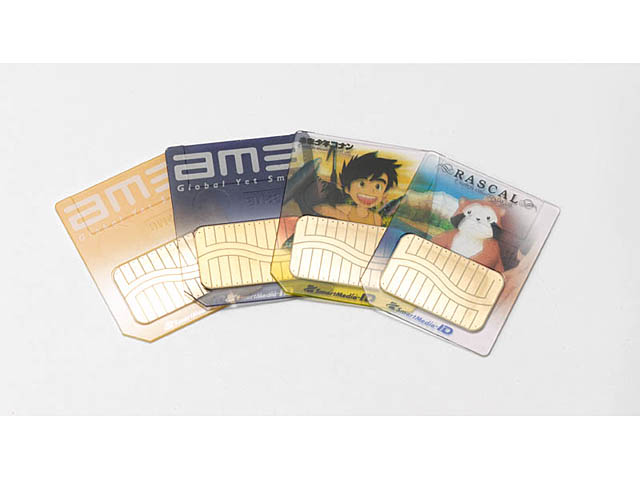
AM3 created a system in 2003 [1] with an adapter that allowed users to insert special Smart Media Cards which contained videos, and that could play these videos. The cartridge contains special software and has a slot on the side allowing the user to insert a standard sized Smart Media card. A wide range of anime titles would be made available for purchase on prerecorded Smart Media cards, or blank anime-themed cards could be purchased.
Individually packaged cards could be purchased with videos on them, or bundled with the card reader adapter. The adapter could also be purchased separately, and with blank Smart Media Cards. Sets of Smart Media Player adapters with blank branded cards could be purchased themed around some series.
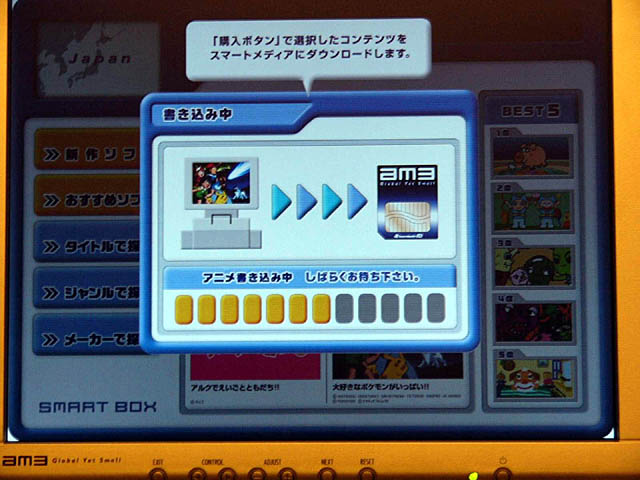
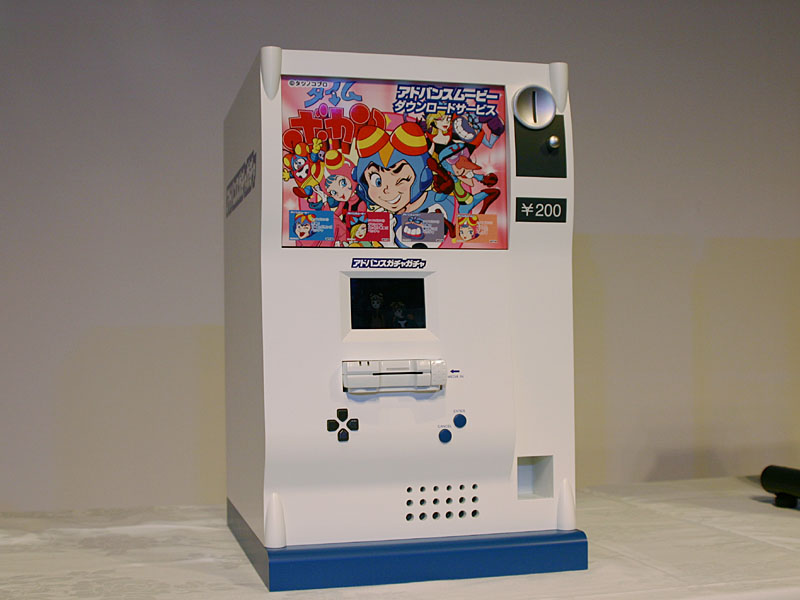
The cards can hold up to 24 minutes of animated content on a standard 32 Megabyte card, or 192 minutes on a 256 Megabyte Smart Media Card [6]. The videos uses a proprietary video compression technology by both Act Image of France as well as IMAGICA Corporation, which is also known for HDCAM video compression [2][2(archived)]. These cards were partially transparent [6]. 4 titles were available at launch in May 2003 and the adapter was available for 3200 yen [7]. Additional titles could be written to blank cards for a price of between 100 yen and 500 yen, and blank cards were available for purchase at a price of 1800 yen. Kiosks were also set up that allowed customers to purchase videos and have them copied onto blank Smart Media cards or write over cards that already have videos on them. There were also dedicated kiosks for one particular program known as 'Advance Gacha' and were planned to be placed in convenience stores and toy stores [7]. This is similar to the way that the Family Computer Disk System in Japan had kiosks set up that allowed users to purchase Famicom Disk System games and have them written onto disks. AM3 planned to have over 10,000 of these machines to copy onto blank cards by the summer of 2005 [4]. The cards were distributed in conjunction with Happinet Co [6].
A mock of an 'Advance Gacha' system
Image from: link
A pricing table has been added below:
Release date
Content
Price
Adapter
November 20
Advanced Movie Adapter
3,200 yen
Adapter + Movie Card Set
November 20
Advanced Movie Adapter Detective Conan 'Roller Coaster Murder'
You might think that the prices listed for a single low quality copy of an episode are expensive at about 25 USD per episode given how cheap it is to buy a digital movie or TV series online, but with this technology, you were really paying for the novelty of it, and at this time, there was really no way to watch videos on the go or in a portable manner, except for perhaps Hasbro's VideoNow which offered content at a lower price point, but only in black and white for the original version and which may not have been released in Japan.
Image Used With Permission, Credit: u/karulg on Reddit
According to the website lik-sang, a former importer of Japanese products, content for AM3's smart media player was planned to be released in stores on CDs with content on them, and which could be transferred to cards [2][2(archived)][7]. It is not known whether these CDs were ever released. This is however contradicted by ASCII corp. which claims that the content would utilise DRM that tied data to hardware in order to prevent unauthorised copying. The system adopted a special ROM-specific ID system recorded for each file, so even if it was copied onto a commercially available Smart Media card, it could not be played. This would be encrypted with DES encryption and use a 128-bit encryption key which would be recorded in the media ROM, and would need to be verified before a video could be played back. Despite this, data from computers and cameras could still be recorded to the memory cards [6].
Unlike Gameboy Advance Video which would not allow users to play the cartridges on the Gamecube Gameboy adapter, the AM3 Smart Media Player could be used on the Gamecube [5]. The adapter is 55 mm long and extends 20 mm out of the GBA [6].
The player has several functions that can be used whilst playing back video. These are play and pause using the 'A' button, fast forwards and backwards, using the right and left buttons on the d-pad respectively, and pressing and holding for forwards and backwards at 1x speed, 2x speed, 3x speed, and 4x speed. Some material would also support chapter menus, although earlier content such as the Detective Conan Roller Coaster Murder Case did not [6]. Titles such as the Pokemon titles would support basic interactive menus which allowed the selection of either the main movie, or short commercials for other Pokemon movies to watch [u/karulg on Reddit].
The player contains no decoding chip, but instead uses the ARM7 CPU of the GBA in conjunction with the specially developed FastVideo codec to allow video playback. This allowed the player to be built at a low price-point as it did not have to contain any custom chips. Video can be played back at 30 fps and at a resolution of 240 x 160 pixels, the full resolution of the GBA screen [6].
Lik-sang, a international distributor expected a wide range of content to be released for the system including [2][2(archived)]:
Animated content
Game and movie previews and trailers
Pictures
Music
Educational software titles
E-books
Karaoke
This is also backed up by a 2004 GameSpot article which claims that AM3 was also planning to release other peripherals that would works with different types of media. These included [4]:
Advance Picture for still images
Advance Music for music
Advance Comic for manga
Advance Navi for maps
According to ASCII, the company was releasing animated content at first, but planned to also release other content such as eBooks, so that the GBA and GBA SP could be used for educational materials. Nintendo however prohibited the company from using the technology to distribute any games or adult materials [6].
Looking at listings for the Smart Media Player on Amazon.co.jp (which can be found by searching for 'AM3' under the category 'TV games'), it can be seen that cards were released for many anime series including, but not limited to:
These releases could have either television series episodes or movies on them. During the time of the Nintendo DS, smart media cards continued to be released with Nintendo DS branding on the packaging, although they were still the same GBA cartridge design. AM3 would go on to release DSVision, which was a similar concept to the Smart Media Player except it took Micro SD/TF cards and was housed in a special DS cartridge that looked similar to a DS flash cart.
The ActImage codec was announced by Shinji Hashimoto, the executive officer of Square Enix to also be planned for use in the GBA game 'Kingdom Hearts Chain of Memories', which did feature rendered cut-scenes. Although from research I cannot find whether it was in fact this codec used to compress the video used in cut-scenes, it likely was due to this announcement [7].
In 2005, am3 would also provide 'Poke Park Advanced Navi' at PokePark, the world's first Pokemon theme park, which was a video utilising the Advance Video technology and could be written free of charge onto a card using an 'Advance Gachapon' system. They also operated a lending system there, where a guest could pay 2100 yen to rent a system with the card and movie, 2000 yen being given back to the guest on the system's return [8].
Currently, there does not appear to be much information on the internet about the AM3 Smart Media Player, or at least it is not easily accessible. Many sites that contain information about the product such as 'lik-sang.com' are no longer available, and many western sites did not cover this product as it did not have an international release, unlike Gameboy Advance Video. It is likely that the Smart Media Player was not released internationally, due to the success of Gameboy Advance Video, and it's much simpler nature only requiring a cartridge for each video, and not a bulky adapter with fancy media cards. Some information can be found through listings on sites such as Amazon.co.jp, which is not normally used by people outside of Japan, which makes it hard for people to discover the AM3 Smart Media Player.
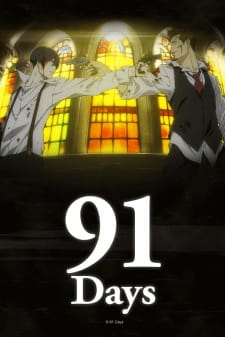
So, 91 Days is a historical anime series set during the course of prohibition America, a time at the start of the 20th century when alcohol became illegal, and which ran from 1920 to 1933. During this time, the mafia ran amok trading moonshine and making their own alcohol illegally. Based on the pretext of it being set during prohibition, we have a 13 year period that this show can be set over. During the series, it is never explicitly stated which year the '91 Days' that this series are over is actually set. You may think that there is nothing that can be done to find the year that this series is set over, but based on what is shown, it may be able to be narrowed down somewhat.
In one episode, a 1921 model 102 Series telephone is shown sitting on a table. This can be differentiated from the 101 as the model shown has a round base as opposed to the elliptical base of the 101 series. While this does not narrow it down it is a start, and suggests that the series takes place after at least 1921.
Throughout the series, a number of people say that they have heard rumours that prohibition is coming to an end. If there are people that are saying that prohibition is coming to an end, you may be thinking that it must be in the 1930s, the last few years of prohibition, but these are just rumours and due to the societal problems that existed during this period, there was much unease and people likely though that prohibition would end at many times throughout this period. It is likely though, that it is near the end of the prohibition period.
While there does not appear to be enough information throughout 91 Days to place the series in a particular year, it is definitely set in at least 1921 due to the telephone shown, and is likely set during the later years of prohibition due to the claims of people that prohibition is coming to an end.
If you noticed anything else whilst watching the series that may be able to more precisely place this series, feel free to comment it below.